Monday, May 7, 2012

My Vocation


November 9, 2011

Some people ask me, “Why are you a religious?”

“Well, God called me to religious life,” I answer.

“That’s it?” They ask further.

“Yup, that’s it,” I tell them.

They don’t seem satisfied with my response. They want to hear something more impressive, more dramatic than that. But I don’t have any story to satisfy their curiosity.

I have a rather ordinary life, with not a whole lot of things to record that might turn into a memoir, for example, the stories of children who are victims of war and violence who have managed to succeed in life, or orphans who were adopted and become famous political leaders.

I was born after the Vietnam War, the youngest child in an ordinary family. When I was young, I didn’t know hardship. If life was difficult, I don’t have memory of it. When I grew up, I heard my mom and brothers and sisters said that during that time, life was really tough. All I could do was listen because I couldn’t remember anything. In fact, my memories aren’t about not having enough food to eat or clothes to wear, but about times when I was playing with neighborhood friends, and my sister would call me home to eat what looked to me was a super sized bowl of rice. No matter how much I ate, it seemed to not be finished. I remember one time, I went to the neighbor’s house, they gave me rice mixed with casava for lunch. It tasted delicious. When I got home, I asked my mom, “Why is it that the neighbors get to have casava mixed in their rice, and we just have pure rice?” I didn’t know that casava was cheaper than rice.

My family wasn’t wealthy, but thanks to my dad who escaped Vietnam and settled in the United States after the Fall of Saigon in 1975, our situation was a bit better off than other families around us. But that was just afterward. Before getting news of my dad and starting to receive support from him, I heard that my brothers and sisters had to quit school and make a living selling cigarettes on the train. But I didn’t understand anything about that. I had it easy. All I had to do was go to school, play with the neighborhood kids, study catechism, and go to church. I remember the times I would wake up to go to church at four in the morning, walking and looking at the moon at the same time. The moon would follow alongside me like a faithful friend. Strangely, wherever I went, the moon was also there.

I followed my family to the United States through the sponsorship program. My life in the new country still only consisted of going to school, hanging out with friends, and going to church. Afterward, I began to join in church youth activities because there was the Fatima Youth Movement established at my parish. I studied hard. My family had high hopes for me, wanting a doctor in the family. I did not have a problem with that. If I were to become anything, becoming a doctor would be the best. You can help people, make money, and you’re also well respected by society. If that’s the case, then there’s nothing to think hard about. I was a high achiever. Ever since I was in first grade, I always ranked first or second in class. So going to medical school wouldn’t be out of my reach.

But in reality, I wasn’t really hung up on being a doctor, and I didn’t give much concern with social status. The one thing that I was interested in was participating in activities. At school, I joined in a lot of clubs, and also played on the tennis team.  At church, I also was active in the youth group. Sometimes, I also took part in social issues like joining in anti-abortion demonstrations and activities to promote environmental conservation. When I did these things, I felt happy. Life had meaning, and I was able to make use of my time wisely.

Perhaps through all these things, God was preparing my heart and mind for a greater mission, not to be a doctor or some kind of person in society, but a missionary. It began with the chaplain priest of the youth group giving me a book about vocation to the priesthood. It was just a thin book, but too deep. I read it but didn’t understand much. I gave up half way through the book. Then there were times when I had the opportunity to meet priests, brothers and sisters in various church activities. They talked to me and introduced me to religious vocation. They looked friendly, happy, poised and faithful. They sang well, spoke with a lot of charm, and shared their thoughts and feelings openly. I observed them and felt that I liked these qualities in a religious person. Then there was a priest friend of the family who came to visit and gave me a book on the life of Father Damien, who served the lepers on Molokai Island. I read his life story, and suddenly, it made me think about what my life could be like.
Would it be that I would not be a doctor who worked in a big hospital or some fancy clinic, but a doctor who goes to work in faraway countries, helping the poorest people in society, treating people that others are afraid to go near?  Or that I would be a missionary who goes to a far off country, serving people who are marginalized and left out of society? These thoughts made me excited and motivated me to focus on being such a kind of doctor or a missionary.  It seemed very compatible with my hopes and desires.

Since then, I began to give more thoughts to religious vocation, in particular missionary vocation. I entered university, still aiming for medical school and majoring in molecular and cell biology. I tried to take my studies seriously so that I could do well in my tests. I even took on a second major in Asian Studies, as this was an area of studies that I was interested in, and I felt it would also make my curriculum vitae more attractive. I also participated in extracurricular activities such as volunteering at the hospital and joining student clubs with the hope that my medical school application would have greater weight. But still, I continued to pray about my true vocation. It was during my first year in university that I met a Divine Word Missionary priest. It was a meeting by chance, though there are many details to the story. Occasionally, he would come to visit me, driving hundreds, even thousands of miles to share about vocation. He never pressured me to enter the seminary. He just came to visit, asked about my studies, gave me some advice and answers to questions and concerns that I put to him.

The university that I attended was Berkeley. There, I had a lot of friends. At Berkeley, students learned hard and played equally hard.  I had a normal college life like most of my friends. But there was one thing in my life, which many others did not have, and that was Sunday Mass. On Sunday evenings at ten o’clock, the church located near the university organized a mass specifically for students. In the day time, most students slept or had to catch up on their studies. So the time they were free was in the evening. This Mass was quite different from others. All the lights in the church were turned off. Instead, candles were placed in strategic places to add ambience inside the church. The church was always filled with people, but the atmosphere was very prayerful. I liked this Mass, and most of the time, I attended it alone. When Mass ended, I would walk back to my apartment. Sometimes, I would pray as I walked. Other times, I would quietly sing a hymn that I liked. Actually, it was not like I intended to sing, but oftentimes, the sentiments portrayed in these hymns would somehow surface from deep inside of me, and come out as music on my lips. Sometimes, I find myself singing, “God, please grant me a heart of love. No matter what bitterness I face in life, let me love only You, so that my life will not be desolate.” Lyrics from a Vietnamese hymn that became ingrained in my mind.  And with these sentiments, tears unknowingly welled up in my eyes then rolled down the sides of my cheeks.

In this way, as time passed by, I found myself increasingly longing for a life more deeply connected to God, a life more committed to serving fellow human beings, and a life more adventurous and interesting than the everyday competitions in academics, the ordinariness of trying to make a living, or the meaninglessness of nights out at the bars and nightclubs. That’s how I decided that I wanted to follow a missionary vocation, so that I could do something similar to what Fr. Damien had done. I gave up the idea of becoming a doctor. I graduated from college, then packed up my belongings to enter Divine Word Seminary, responding to God’s calling.

That’s it. There is nothing so dramatic. My life will never become a play for the stage, even if just a small one. If one asks why did I become a religious, the answer is, I became a religious because God called me, a calling that was gentle and unceasing. God did not strike me with lightning, or cast a wind sweeping me into religious life. He simply journeyed with me, much like the moon of my childhood, always following me every time I walked on the small village road that led me from home to church. He gently instilled thoughts in my mind through the gestures, words and actions of those around me. And he inspired me with desires and longings surging from deep within my heart that at times, seemed suffocating. And this way, the wide open road to the future for me became more narrow as I recognized a small path to turn into. That small path in turn became a wide boulevard leading me, a missionary, to the vast mission fields where I am serving today.

I am recording these memories during the time which I am serving in northeast Thailand, where the people are harvesting their rice crops. These rice fields never lack field hands. But as for the mission field, the words of Jesus were true in the past as they are true in the present. The harvests are plentiful, but the laborers are few.

Friday, January 21, 2011

A personal take on addressing the HIV/AIDS issue

I remember when the HIV/AIDS epidemics first became widespread and everybody – from governments to civil organizations – panicked. They devised all kinds of campaigns to fight against the spread of this terrible disease. They told people that HIV was an incurable disease that if you got it, you were pretty much given a death sentence. People who had HIV were drug addicts, prostitutes, homosexuals, and people who led rather impure lifestyles. HIV was something that everyone had to fear. People were also led to fear those who suffered from it. Thus the public learned to be both afraid of the virus as well as the people who carried it. HIV/AIDS sufferers became rejected by their family and ostracized by their community.

The stigma associated with HIV/AIDS is still prevalent in many countries, and in Thailand, it is also present. Unfortunately, old impressions die hard and nowadays, HIV/AIDS sufferers continue to be feared and avoided by others. A few days ago, Joe, an AIDS patient at the Mother of Perpetual Help Center told me that when he was in the hospital the week before, none of the patients in the ward dared to come close to him. Everytime a new patient came, the patients already there would warn them about Joe. “I was so embarrassed the whole time I was in the hospital,” he said.

It is this reality that has inspired me to create activities in my ministry that aim at bringing people together to bridge differences and misunderstandings. While I believe that in order to solve a problem, one must address it head on. Thus, matters related to HIV/AIDS need to be taught to the people, especially students in school. Thepublic need to hear the truth about HIV/AIDS and need to hear the stories of those who suffer from this disease. People with and without HIV/AIDS need to share with each other about their experiences to create sympathy and understanding between one another.

On the other hand, I also believe that somethings don’t need to be constantly talked about. People need a chance to live just as people, doing the things that people do, and relating to each other not based on labels or blood test results, but based on the essence of being human.

Thus is the nature of many of the activities that I create in my work. Youth with HIV do volunteer work beside those who do not have the virus. Parishioners in our church who come from the general community worship side by side with AIDS patients from the hospice located next to the church. Children from the community engage in activities alongside those from the home for orphans with HIV. Young people with and without HIV cook and eat with each other whenever they come for group meetings.

The focus of the activity at hand is the worship, the learning, the working, the sharing of the food, etc.. The focus is not on HIV/AIDS and it doesn’t have to be. Our activities let people be people. It is not hiding the fact about HIV/AIDS. Nor is it avoiding the issue. Everyone who comes to the church, or to the class, or to the activity knows the backgrounds of the people around them. Yet, they come because they accept the people that they meet and they enjoy the activity that they are doing. It is not uncommon for a youth who doesn’t have HIV to remind her friend that it’s time to take her retro-viral medicine. Nor is it uncommon for a casual conversation between a young person and a hospice patient to revolve around the patient’s health problems.

Will this have a positive effect on the HIV/AIDS issue? I believe it can. I believe by simply being together, the acceptance will be both ways. People without HIV/AIDS will come to realize that they don’t have to be afraid of those who have the virus. On the other hand, people who are infected with HIV may realize that it is OK for them to be a part of society, and that there is a place for them in the community. The issue of HIV/AIDS acceptance will improve when the community opens their heart to those who are positive with the virus. And it will also improve when HIV+ people do not isolate themselves from society. My role, I believe, is to facilitate the opportunity for such meetings to take place, so that understanding, sympathy, and acceptance can take shape and grow.

Thursday, January 20, 2011

Reflecting on the Jesus Youth 25th Jubilee Celebration


5 January 2011

In today’s society, young people are taught to study hard to be successful in life. It’s not bad advice. After all, to have a college degree, a respectable profession and the perks of modern life is important and something that we should strive for. But in the midst of our ambitions for material success, oftentimes, we forget that there’s more to life than education, career, and possessions. We forget that in the end, all those things are meaningless if they are not placed in context of something even greater and more profound, which is is to serve God and our fellow human beings.

Unfortunately, for so many people this more profound spiritual dimension of success never surfaces in their consciousness as they go about preparing for university entrance exams, graduation thesis, job interviews, and acquirng money to buy the things they need and want in life. It is this reality that makes me worried when looking at our society, and makes me feel so overwhelmingly grateful when I think about the members of Jesus Youth Movement.

At the 25th Jubilee Conference held from 28 December 2010 to 1 January 2011 in Kochin, India, I had the chance to meet many members of Jesus Youth, from just regular members to individuals who devote full time to the work of the movement. They were university students who majored in all sorts of fields. They were post grad students in medicine and engineering. They were professionals in information technology, film and music. They represented the ambitious, technological suave, hard driven members of generation X and Y. And yet, something distinctly set them apart from the stereotypical Xs and Ys – and that’s their zeal and love for God, for the Church, and for the mission of the Church. They realized that their ability and gifts were to be put to the service of God. They were not afraid to pray and praise God before others. They were not hesitant to sacrifice their time and money for the work of the movement, which is to proclaim the Good News to all the ends of the earth – a command that Jesus did not mean just for priests and religious missionaries, but for all God’s people by virtue of our Christian baptism.

At the Jesus Youth Jubilee Conference, among the 22,000 participants, there were many bishops, hundreds of priests and over 1,000 sisters. It was an inspiring sight to see the leaders of the Church coming to participate, to encourage, and to show their solidarity with Jesus Youth, which is essentially a lay movement. But for me, the words and images that are most edged in my mind did not come from the cardinal, the bishops nor the priests. But they came from the passionate testimonies of Jesus Youth members, the prayers that the singers said in between powerful Christian rock songs praising God, and the words of reminder from Jesus Youth professionals that we priests are needed to accompany them as they carry out the Church’s mission. I also remember the images of many youth who came up to me to talk and ask for blessings, of the thousands of hands raised in intent prayer, of eyes closed as the youth said the Rosary praying for the New Year’s Eve downpour to stop so that the program could go on.

Looking back on the Jesus Youth Jubilee Conference, I feel humbled by the skills and talent of the members, encouraged by their missionary spirit, empowered by their prayers, and grateful for the opportunity to participate in the conference and to accompany the Jesus Youth Movement as we try to proclaim the Good News here in Thailand.

I pray that as our Thai youth try to climb the social ladder to be on par with the youth of the world, they will remember the true purpose of everything that they are striving for. The model of Jesus Youth Movement is one that we can certainly adopt and immitate in order to bring about the Kingdom of God in our lives and our world. Let us begin by imagining that the zeal and love for God and for the Church that was seen at the Jubilee Conference can be seen here in Thailand, among our youth and in our very churches.

Sunday, August 22, 2010

Mission on the mat: church youth group shares food life, and hope


By Anthony Duc Le, SVD

Eating in the Thai culture


Eating together is an important social and communal activity in every culture and society, and for Thai people, it’s no exception. When there are events that involve serving food, those in charge invariably have to think about how much and what kind of food should be served. At my church, this issue often dominates the parish council meeting conversations. For example before our annual church feast, we spent a large proportion of time on this very topic. After the event had already occurred, we talked about whether the food was enough for everyone, and what we should do for the next celebration. Likewise, in our First Saturday gatherings at parishioners’ homes for prayer and scripture sharing, despite my urging that this be a simple affair because I did not want to make it a burden on the host, the parishioners themselves refuse to make it so. No one leaves the house without first being fed. Even when the host family is rather poor, they still manage to get enough food together to serve everyone.

Eating being a part of family, community, or other group gatherings is a requisite for the Thai people who have their own unique way of sharing food. When Thai people sit down for a meal, they usually share the various dishes that are placed in the middle of the table. A pot or container of rice is placed on the side. Dishes differ from region to region. However, most meals consist of a soup, a spicy dish, a vegetable dish, and some fresh vegetables. Unlike many of their Asian counterparts, Thai people nowadays use forks and spoons rather than chopsticks, which are reserved for noodle soups such as kuaytiaw. In the countryside, people often eat with their hands, which is the style of eating practiced before utensils were introduced. For example, in the Northeast region of Thailand, people often use their hand to pick up a piece of sticky rice, dip it in a spicy dish and then put it in their mouth.

Usually the dishes placed in the middle of the table come with a serving spoon. But it is not uncommon for Thai people to serve themselves with the utensils that they use to eat. In people’s homes, especially in the countryside, Thai people often eat sitting on a mat spread out on the floor inside or in front of the house where it is a bit cooler. However, eating in such an open space also requires them to invite neighbors to join everytime one passes by. It is a polite way for the people to continue their meal without feeling like they are being unhospitable. Usually, the passerby politely refuses the invitation and goes on his way leaving the family to eat in peace. Eating for Thai people is a relationship building activity in many ways, and an important part of people’s everyday life. It is no wonder that when Thai people greet each other, they often inquire whether they have eaten or not.

The Christian Agape meal

In reality, it’s not the Thai people alone who employ the occasion of sharing a meal together to enhance or solidify good relationships through the sharing of conversation, jokes, stories, and of course, food. In almost every culture, friendships and communities are often formed and strengthened through meal rituals – both formal and informal. In the Gospel accounts, Jesus was often seen eating with many people –his disciples, community leaders, and even sinners. Sharing food with these people were an important part of Jesus’ ministry and actually afforded him many unique teaching moments. Sharing in a meal with others allowed him the opportunity to convert and transform the lives of people like Levi the tax collector and his friends who were castigated by society (Mk 2:15-17). Accepting meal invitations presented him with perfect scenarios to teach those such as the Pharisee named Simon on the relationship between love and forgiveness (Luke 7:36-50). Breaking bread with his disciples on the last night before he was arrested and hung on the cross allowed Jesus the occasion to say profound and sincere parting words to them, and taught them the way to remember him in the future (John 13-16).

So it is not surprising that in the early days of the Church, Christians would gather around the table in people’s houses to share food and fellowship, sang, and prayed to remember Jesus. This meal is what came to be known as the agape meal, or the love-feast. This act of worship and fellowship would eventually evolve into the formal Eucharist that we see today. However, as the formal Eucharistic celebrations began to take shape, in the past, agape meals often were still held as an activity separate from the Eucharistic celebration. Today, at many churches, agape meals often take on the characteristic of after-mass social, Saturday night potlucks, or even full out meals in which members sit down around the table to share food and fellowship. At one of the churches of Fr. Truc Phan, SVD in Nong Khai Province, every Sunday, the villagers bring food to share with each other after Mass. All these things act as an agape and provide opportunities for building community spirit and unity.

From instant noodles to agape meal


When I first came to St. Michael Archangel Church in Nong Bua Lamphu in April 2008, I was quite disappointed by the lack of spirit in the church. I witnessed a situation in which few Catholic families came to Sunday Mass. I had no altar servers, no assigned readers, no organ player, and no organ. Music that accompanied community singing came from a recorded CD that was used every week. Needless to say, the pre-recorded music did little to enhance the dismal atmosphere in the church.

One of the few bright signs in the church that I saw was a group of 4 teenagers, 3 girls and one boy who came to church every Sunday for catechism. All four had been Buddhist since birth. The three girls had been recently baptized by the former pastor, although their catechism training had been limited. One of the girls came from the orphanage for HIV+ children located behind the church, and the others came from the community.

The catechism classes took place in the afternoon because the teacher had to travel to Nong Bua Lamphu from Udon Thani, the province next over. However, Sunday Mass was at 8:30 a.m. After Mass, the teenagers would often hang out at the church because they did not want to go home then come back for catechism. As lunch time came around, the youth would often ask for instant noodles or whatever food I had in my refrigerator to eat. I let them use the kitchen of the rectory to prepare the food because there was nowhere else to cook the food. Other than the church building itself, the only additional parochial building was the recently built rectory. Even the girl who came from the Children’s Home did not go back but chose to eat lunch with her friends at the rectory. Eating at the church while waiting for catechism class, therefore, became a regular and necessary activity.

As I invested a significant amount of time and effort into building up youth ministry at the church, their presence at the church became common. So was the sight of youth eating together at the church, usually informally. Vietnamese youth who come to find work in Nong Bua Lamphu often came to visit me at the church, to study catechism, or to help clean the rectory. Oftentimes, they end up cooking using what we could find in the refrigerator to make it into a meal. Youth who come to participate in Saturday activities such as doing volunteer work in the village or attending activities at neighboring churches also often find themselves returning to the parish afterward to hang out and eat.

From a group of four teenagers, the youth group in the church has now grown to over 20. Some of them come from the community. Some of them have grown up from the children’s home. Some of them are young adults who are Vietnamese migrant workers who have made their way to Nong Bua Lamphu, and subsequently to the Catholic church. Some of them are HIV+ teenagers who have recently come to live at the Mother Mary Home.

As the number of children and teenagers who come to the church grow, so do the activities designed for them. After Sunday Mass, children learn catechism or musical instruments, or life skills classes, depending on the development of church activities. Presently, activities for the youth (age 13+) take place all morning and officially end after lunch – a meal in which they cook and share together as a group. Thus, from merely giving the youth instant noodles to hold them up until catechism, the Sunday meal at the church now is a formal youth group activity that is participated by many of the youth group members.

Youth group meal as an extension of the Eucharist


While the youth group at the church has grown much larger than the few members just two years ago, not all of them are Catholic. Some are still studying catechism awaiting to be baptized. Some youth who come to the church do not have an interest in studying catechism, and cannot be forced to follow Catholicism against their will. Still, they come to church and participate in Mass. The church youth do virtually everything in the liturgy – serving at the altar, doing the reading, playing the organ (we now have one), leading in the praying as well as the singing. They also do many things outside the liturgy as well. However, the Eucharist for the youth, has not been as much a symbol of unity as desired because not everyone is receiving Holy Communion or on the track to receive the sacrament. It is a situation that is regrettable from the perspective of a parish priest, but it is a situation that I accept with peace and trust in the mercy of God.

What is so far not possible in the Mass is made up for in the youth meal, which is something that everyone is invited to participate in without any obstacles. All are welcome to partake in the food before them and to enjoy the conversation taking place in the group. The youth group meal is the agape meal that becomes an extension of the Eucharist for the youth, and is the activitity that all who come do not have to feel that they are “left out”.

Youth group meal as an act of sharing and participation


Every Saturday morning, when it is still early, Nong Bua Lamphu’s morning market is full of activities. Thewarat Thailampoo, a former seminarian who is now a regular church staff, goes to the market to buy two things – flowers for the church and groceries for the Sunday youth meal. His budget used to be 200 baht for flowers, and 300 baht (about 9 USD) for food. Usually, he buys some meat, some eggs, and some vegetables. He buys things that he thinks the youth can easily use to make a meal.

On Sunday morning, at about 11 o’clock, about five of the youth are assigned to go into the kitchen to make lunch for the group. The rest engage in other activities. Some are cooking experts, but most are not. Yet, they make do with whatever they find in the refrigerator. Their job is to come up with about four dishes along with a big pot of rice enough for the number of people present. They don’t always estimate correctly how much rice or food is needed. Sometimes there’s way too much left over. Other times, the food is gone, but people are still not yet full.

Those who don’t have the responsibility of cooking do the setting up, cleaning, and washing. The group leader has a list of people assigned to the various tasks from week to week. Despite the attempt at a system, chaos is not unusual. Still, every week, the group manages to find enough people to cook, to clean, and to wash.

Youth group meal as an act of unity and acceptance


The taste of the food that appears on the mat spread on the ground in front of the church differs from week to week, from people to people. However, no words of complaint have ever been heard coming out of the youth who join the meal. Perhaps they themselves are too aware of their own cooking ability to dare criticize others. After all, eventually, it will also be their turn to do the cooking. But most likely the reason many stay for the meal is not for the food but rather for the friendship and the fun of cracking jokes at one another during the meal. So the taste is not so much an issue.

The group eats sitting down on the mat, and the eating takes place after the prayer of thanksgiving has been said. Saying grace is the duty of one of the youth who did the cooking that day. Around the food, the members share in the food that they themselves made. They make jokes, talk about the things that young people talk about, and generally enjoy being with one another. I also use the occasion to share with the group some news about the church or about upcoming group activities. I also use the occasion to give comments to the group—praising them for good things that they have done, or remind them to do better in other things. I try to keep negative things to a minimum in this task because it is important to not make people lose their appetite during meal. Just as we begin the meal with a prayer, we also conclude the meal with one. And nobody leaves the mat until the final prayer has been said.

Youth group meal as an act of service

Most youth don’t like to cook and few like to do dishes. But here, they are taught to do both. Serving each other is at the heart of the youth group meal together. Cooking for each other, helping each other to clean up, and washing the dishes become acts of service for one another, and teaches them to value a life of service and cooperation. They not only serve during the meal but also serve in their daily lives. We hope that they will learn to serve the people in their family, the abandoned elderly in their community, the friends at their school, and the poor in society. Oftentimes, the youth group do activities such as going to visit the elderly, or do something for the church. Thus, by creating opportunities for the youth to serve one another in the meal, we hope to also remind them to serve one another in everyday life.

Youth group meal as an act of hope


Everyday there are countless meals being eaten all over the world. But eating together does not always mean building relationships if the participants do not put their hearts and minds into the activity. However, in the youth meal, I believe many of them do. Seeing the youth making food together, sitting side by side, and sharing the food that they have made inspires a tremendous sense of hope in my heart. It is the hope that in this world, people from all sorts of cultures and life situations can come together and accept each other in a sincere way. It is the hope that others will look at this simple group and see God’s love reflected in their interactions with one another. It is the hope that in Christ, there is no Thai or Vietnamese, no HIV+ or HIV-, there is no rich or poor. For everyone, no matter who they are, are the children of God.

Conclusion

Ever since coming to serve at St. Michael Archangel Parish in Nong Bua Lamphu Province, I’ve tried to create many activities—both pastoral and social. It’s been thoroughly a trial and error experience. Some activities have seen great results with community support. Some barely get off the ground. Some go well for a while until something happens and puts it to a halt. The Sunday youth meal as well as all the times when the youth come together to share food is for me a particularly meaningful act. It is not easy to create an orderly system with the cooking and the cleaning, and sometimes the food takes a while to be ready. But I believe many of the youth try their best, and sharing food with the youth has always been something very foundational in my youth ministry. When I see them eating together, young people sitting down around the table, serving one another, talking to one another, and relating to another, while all around them, society is becoming ever more individualistic and inward looking, I feel a tremendous sense of satisfaction and thankfulness because I believe that I am creating an opportunity for people to bridge differences and create community. And it can be done with a simple meal.

Friday, August 6, 2010

Bangkok taxi ride


I am sitting in a taxi trying to make my way down Sukhumwit Street in Bangkok. It’s raining and the traffic is jammed, not that it’s not jammed virtually all day and much of the night. I strike up a conversation with the taxi driver.

“How long have you been driving the taxi?” I ask.

“About four years,” he answers succintly.

“What were you doing before that?”

“I was working with my brother in a family business.”

“Where’s your family?”

“In Nong Bua Lamphu.”

“Really?” I am surprised. “I’m working in Nong Bua Lamphu now.”

“Really?” It’s his turn to be surprised. You don’t bump into too many people from Nong Bua Lamphu in Bangkok. Not that there aren’t people from this province trying to make it in the big city, it’s just that NBL is a small province, and Bangkok is a big town. They get spread out and so you don’t bump into too many of them.

“What do you do in NBL?” he asks me.

“I’m a pastor at a Catholic church. We’re also trying to do some programs to help the community,” I answer.

“That’s great,” he says. “NBL needs a lot of development.”

“It’s better now than it used to be, I think,” I observe. “But there’s still a long way to go.”

The taxi driver nods his head in agreement. As he stops at the intersection of Sukhumwit and Asok, waiting an eternity for the red traffic light to turn green, he tells me about what he used to do to make a living in NBL, and since it just wasn’t enough he decided to try things out in Bangkok. It’s not easy driving the taxi, but at least he’s got more to send back to the family in NBL so that the children can go to school and have the things they need.

Back in NBL, I’m making use of my role as pastor of the province’s only Catholic church to make some contributions to the development of the town. It’s not much, but it’s something. Before I came and at present, the Mother of Perpetual Help Center run by Br. Damien Lunders, a veteran American missionary has been making an impact on the HIV/AIDS care and prevention program in the region. People in town all know about the center and its work. They know about him too, because he’s one of the few Western men in the province who don’t have a Thai girlfriend or wife. It’s still something that some local people haven’t gotten a grasp of.

The AIDS center is right next to the church. People in town know more about the center than they do about the church, partly because of the widespread work done by the center, partly because ever since the church was built, none of the priests who came to be pastor here stayed long enough to help the parish develop or to start community outreach programs.

We’re trying to make up for that now. So we got programs started. Got the youth together to have activities, get community youth and children from the AIDS orphanage to come to the church to participate in summer programs, year-long programs, and special activties. Now we’re establishing a house on a big piece of land belonging to the diocese at the foothills of NBL mountains, right behind the provincial hospital as a place for people who need temporary shelter, especially the poor village folks who come to the hospital to visit and take care of sick family members. Some stay for a few days, others for weeks. They end up sleeping on the hospital corridors, or camp outside on hospital grounds. It’s a pitiful sight to see. So we’re opening up this place to help people like this, people who are “strangers” among our midst.

The traffic light turns green. The taxi driver shifts gear and starts to cross the big intersection. Overhead, the Skytrain zooms past us, its railway supported by heavy concrete structures that consume up a big part of the space in the middle of Sukkhumwit Street. Here if you look left, you see buildings – hotels, banks, restaurants, bars. If you look right, you see more buidlings – massage parlors, departments stores, tailor shops, and so forth. If you look around, you see taxis, cars, food vendors, motorbikes. If you look up, you see concrete. No sky in sight. That’s Bangkok. That’s what people leaving NBL and the other small towns of Thailand are heading to. That’s what my taxi driver came to see when he left NBL four years ago.

But for me, NBL’s got its own subtle charms. Sometimes, it’s nice to be riding your motorbike down the road that runs around town, taking in the fragrant scent of new rice stalks after the rain, trying to dodge the cows crossing the street, and in front of you is the sky full of gray clouds trying to break apart after the rain has already stopped.

Tuesday, June 1, 2010

Overcoming language barriers in a new culture


When I came to Thailand, the first thing that I did was study Thai. I enrolled myself in a language school in Bangkok and spent the large part of my day pining away at the Thai language – grammar, vocabulary, pronunciation, and eventually , reading and writing Thai characters. Fortunately, I somewhat have a gift for language because I managed to pick it up rather fast. A few months later, I could read simple writings, order my food at the restaurant, negotiate prices at the market place, and understand the fights that occurred on Thai TV drama.

Nonetheless, people told me that the Thai that I was learning was not going to be the Thai that people in the Northeast, where I would end up working, were using. People in the Northeast didn’t speak Thai, they said. They spoke Isan. What? Isan! What’s that? It’s like Laotian, they said. I was a little bit worried. How was I going to understand them if we didn’t speak the same language?

Still, I persisted with learning Thai because it was the national dialect. After my language preparation time was over, which consisted of five months of studying at the language center and another three months of self-study, I packed up my belongings and moved up to the Northeast. I was expecting to find myself in a totally different country with a different language, but it turned out to be a lot less scary than I thought. As it turned out, people in the NE did speak Thai. And they did understand what I was saying. I also understood what they were saying, that is, unless they spoke Isan.

Isan is the local dialect of the people of the Northeast, which is the biggest region of Thailand. It’s comprised of many provinces. And the Isan spoken in Khon Kaen isn’t necessarily the same as the Isan spoken in Sakon Nakhon or in Nong Bua Lamphu. Still, it was the Isan language, and people who spoke Isan generally understood each other. People in this region converse with each other using the Isan dialect. However, in official settings, ceremonies, the classrooms, and the like, people used the “Central language,” which is the dialect used by the people in Bangkok and the central region of Thailand. I was grateful for this reality.

It’s been over two years since I’ve lived in the NE, and if I were asked whether I could speak Isan yet, I’d have to truthfully say that I still can’t. Isan dialect has its local vocabulary, and its own method of intonation, which I have not been able to catch on yet. Not that I’ve actually tried to learn. I’m just happy to be semi-fluent in the language that I started out with.

Still part of me wishes I could speak Isan. I envy my assistant who is from the Northeast and can make children laugh in the colloquial language. I get frustrated when I go visit the elderly in the village and have to pretend to understand their answers to my question, which are almost always spoken in Isan.

Right now, I have not made it a goal yet to be able to speak Isan. Although, I do find that as the days go by, I’m beginning to understand the Isan more, sort of like the way the old folks understand my central Thai but don’t speak it. There’s less guessing or pretending going on than before.

Indeed, to be able to communicate in the same language is so important to building relationships and intimacy. It is a challenge on the part of foreign missionaries like myself to overcome barriers of language, culture, customs, and worldviews. It is a daunting task, but it can be done if we are willing to listen and be patient. Eventually, that word that the people pronounce so differently from the way you’ve learned in school will suddenly sound familiar and natural. And you don’t even realize that it’s being pronounced in a different way.

Nong Bua Lamphu, 1 June 2010

Monday, May 17, 2010

Building peace amidst conflict in Thailand

The glitzy part of Bangkok where there are five star hotels, luxurious shopping centers, and even a prestigious country club, have turned into a battle field. Lumpini Park, the biggest and most beautiful park in the city is no longer safe for morning jogs. Along the fence that encloses the large park, soldiers have put up camp and are shooting at people with M16s and real bullets. And even though on the television channels broadcasting news of the months-long protest and confrontation between the “Red Shirts” and the police and military, the SMS messages rolling across the bottom of the television screen urgently call for peace and tolerance, the scene on the street betrays any such spirit.

On Thursday evening, May 13, as my taxi took me to Phetchaburi Street for dinner, we had to drive by Withayu intersection, where only minutes before, a rogue general who supported the Red Shirts had been shot in the head. I, of course, did not know what had happened, not until a friend called me later and told me to be careful since shooting had begun in the area. Leaving the buffet restaurant to return to my hotel in Bangrak district, I had to convince the taxi driver that there would be a way to get to my hotel. Still, we had to pass by the area where violence was taking place. To my surprise, people were crowding around, stopping on their motorbikes, as if to take in the scene of a festival. Weren’t they worried to get hurt, or die? I thought to myself.

The next morning, I had to go to the Vietnamese embassy at 10 a.m. to pick up my passport and my 5-year visa exemption document. The Vietnamese embassy happened to be on Withayu street, which was blocked off to traffic, and the American Embassy, which was less than a kilometer down the street, had also been closed. A friend of mine called into the embassy and was told that the Vietnamese embassy was open for business. But to get there, I had to take a taxi from my hotel, got on the expressway which seemed to go in the opposite direction from my destination, and finally got to an exit that was not too far from the embassy. Unfortunately, the exit had been blocked off. I had to get down from the taxi and hop on the motorbike to make it to the embassy. But even then, it wasn’t a ride without detours.

Friday afternoon, the violence escalated even further. More streets were blocked. Shooting spread to Praram 4 Street. Sathorn Avenue was closed as well. Vehicles from those streets started to pour into the tiny soi and alleyways inside, creating congestion that lasted for hours. At 1 p.m. I got on the taxi to go to Minburi District on the outskirts of the city, where I was scheduled to celebrate a wedding at 4. I just barely made it to the church on time.

Four days later, the tension and danger in Bangkok have not waned. Fighting are still taking place. Various sides are still standing their grounds, not the least, the government, which has decided that it has to forcefully remove the protesters. The government rescinded its peace plan offered last week after the protesters demanded even more. It has also given the protesters a deadline for dispersing.

Here in Nong Bua Lamphu, nearly 600km away from Bangkok, and the home of many “Red Shirt” supporters, the streets are peaceful. But there is a war broiling underneath, at least in words. Everyone seems to have an opinion about the other side. And the words reserved for them are usually not every pleasant. In Bangkok, getting on a taxi, one knows which side the driver is on by the radio station that he is tuning in.

At my church, we don’t take sides even though the last month, we have constantly been praying for peace in Thailand. Every Catholic church has been encouraged to pray for peace. Many Catholic lay groups are doing the same. But, as I said in church last Ascension Sunday, praying is good. But it’s not enough. We have to build peace by our own actions. Peace, and the kingdom of God are something that we don’t wait for, but actively make happen in our own lives and the lives of others.

My various projects in the Life Ruam Kan program aims to contribute to this peace building process. We want to create bridges for people to be able to come together, to get to know one another through dialoging with one another, and sharing their lives with one another. We want to build a community that accepts and celebrates diversity instead of fearing it and making it a source of conflict.

Next Sunday is Pentecost. In our church, we will have the prayer of petitions in multiple languages – Thai, Vietnamese, German, English, Tagalog, and Indian. These are some of the languages present in our community. No doubt we will be praying for peace, peace that will come about through our own efforts alongside with those of others who realize that actions need to go along with words.

Nong Bua Lamphu, 17.5.2010

Wednesday, April 28, 2010

Summer camp pictures

This was the second year I organized the Summer Youth Camp. The theme of the camp was "Opportunities and Challenges for Young People in Today's Society." This year, I took the camp to Nong Khai Province, to a location close to the Mekong River. I wanted to change the atmosphere for the youth from my church, so it was good to take it to a place rather far away - about 200km. 

The camp site was actually on the grounds of Fr. Truc Phan's church, which is located in a small village surrounded by rubber tree farms. Most of the activities took place on site. However, on the second day of the three day camp, we took it to the Mekong River where we had a hike to the river, listened to a presentation about the river and the environmental issues that the people depending on the river are experiencing, and of course, playing by the river. In the evaluation forms, many indicated that the Mekong experience was their favorite activity. The aim of the second day's activities was to create social awareness, especially environmental awareness, for youth people.  

On the third day of the camp, the youth went into the village to visit the sick and abandoned elderly. This activity was meant as a lesson in having the spirit of volunteerism and taking concrete action to make society better.

The second and third day's activities were different from the first day's activities which focussed more on stirring the heart and mind of the youth through talks, discussions, and sharing.

The camp was successful and received good feedback from the participants. And the best thing about the camp was that after everything was accounted for, we remained slightly in the black. And the whole camp was paid for through individual donations.

Nong Bua Lamphu, 29.4.2010 

HIV/AIDS Center Needs Support


Nong Bua Lamphu: A place appreciated by few


When I first came to Thailand and spent about half a year studying Thai in Bangkok, people often asked me about where I would work after I finished my language studies, I told them Nong Bua Lamphu. Oftentimes, the question I received immediately after that was, “Where’s that?” And it’s not necessarily the foreigners who asked me this question. Thai people asked as well.

Eventually, I found out the reason why so many people asked me this question was because Nong Bua Lamphu was a rather unknown province, even for Thai people. And amongst the ones who knew, many asked me why I would want to go there since for them, NBL had few things that would attract them. I had to explain to them that there were work already in place in NBL that I wanted to collaborate.

You can’t blame the people for not knowing about NBL or thinking highly of it. NBL is one of the youngest, smallest, and poorest provinces in Thailand, nestled in the middle of Udon Thani, Leuy, and Khon Kaen provinces in the northeast region of the country. NBL means “Lamphu Lotus Pond”, which is a rather attractive name.  It has a half a million population, the majority of whom live in rural villages that make up the 6 districts. The central district has parts that are more developed, but it’s not yet ready to be a city.

Nong Bua Lamphu is not a tourist spot, even if there are a few tourist destinations. The activity that attracts the most people is the weekly Tuesday afternoon market where all sorts of goods are sold cheaply.  In the center of town is a lake where both swimming and fishing are prohibited. Next to the lake are sports grounds where people come to play football, basketball, and do outdoor aerobics in the afternoon. These grounds also serve as the place for festival events that take place in town.

Many people from NBL make it a point to leave it when they have a chance. Young people leave to find education or work opportunities. Adults also leave to find jobs. In the villages, many old people are left living alone or to raise grandchildren whose parents have already left to find jobs in Bangkok or other big cities.  Usually, they work in factories, restaurants, or construction work. Many end up working in bars and even the sex industry, which makes them susceptible to getting infected with HIV among other problems.

Even though NBL is not a highly developed province, but the youth of this province also have access to the internet to know what’s going on in the outside world. Even though they benefit from the new technology, the good comes with the bad. Many youth are addicted to computer games and internet. Because they don’t live in an environment where there are many social and cultural programs are afforded to them, they end up spending more time chatting on the internet than they do reading books or engaging in other beneficial activities. Even if they are ambitious and work hard in their studies, it would be difficult for them to obtain quality education in Nong Bua Lamphu since the local government is limited in its means.

The Life Ruamkan Program aims to contribute to the governmental and private efforts being made to address some of the issues prevalent in this province. We hope our model of coming together as a community of people from diverse backgrounds and social status to study, work, and play together and to support each other, it will inspire each of us and others in the community to continue to expand this model further in other life situations that they are in, contributing to a more peaceful and compassionate society.

Wednesday, April 7, 2010

Is it called superstition?

A while back a confrere of mine came to Thailand for a visit. This was his first trip to the country. I took him around Bangkok and other places to visit. I tried to inform him about the Thai people and culture as best as I could, and to the best of my understanding after having lived and worked in the country for over two years. Of course, I took him to the temples and the shrines where many Thai people, both Thai and tourists, came to visit or to pray. Later on, I was told that my confrere went back, and in an official meeting of the congregation, made an observation that he felt ashamed when he heard me making the observation that Thai people were superstitious. I of course was not present in this province wide chapter, so I never had the chance to respond to his comment nor could I make any defense as to why I believe my observation was justified.

I am not exactly sure why the term "superstition" has turn into a sort of non-politically correct word in the world of missiology or inter-religious dialogue. I am not a linguist, nor am I a missiologist, even if I am a missionary. For me, certain behaviors are best described as superstition, even if it makes the politically correct people grimace at such a description.

I myself grimaced yesterday when I found out that behind my rectory, there is a banana tree with supernatural powers. A few days ago, two of the AIDS patients in the hospice went around looking for numbers to buy the lottery. They came upon this otherwise ordinary looking banana tree behind my rectory and saw that somehow, someway, the sap from inside the tree had oozed out to form certain numbers on the surface (or what they thought to be shapes of numbers).

The patients decided to select these numbers to buy 200 baht worth of lottery tickets, and lo and behold, they won. The numbers appeared on the outside of the banana tree were apparently correct. As a result, the two men decided to give offerings to this banana tree by tying a ribbon around it. In addition, they brought a chicken and some energy drinks, as well as candles and incense to make offerings to the tree.

I never actually saw the act taking place. Only the following morning, I was informed by one of the youth that this had taken place. I went out to look and of course, I found what was left of the incense and candles left amidst the pile of dry leaves at the bottom of the banana bush.

I was imagining that with this banana tree having special powers to help people win the lottery, the word would go far and wide, and soon people will be coming in droves to look for numbers that the tree has to offer. But so far, no such phenomenon has taken place.

The only thing that has taken place so far is that I have gone to the staff of the AIDS hospice and asked her to tell the patients that I do not approve of this type of offering taking place on the grounds of my church. And after I told Brother Damien, the director of the MPH Center about what happened, he asked me to add the Mother of Perpetual Help Center grounds to the prohibition as well.

So far, the ribbon around the banana tree remains tightly wrapped. I've been looking at the tree occasionally from inside the rectory to see if there's anything unusual about it. But so far, nothing much has happened. The only unusual thing that has occurred is that another tree in the same bush has somehow fallen down behind it. Unfortunately, there are young bananas growing on the fallen tree. I wonder if a blast of wind has caused the fall, or the gardener has decided to cut it down, or this was the result of the overwhelming power coming from the tree that oozed correct lottery numbers.

Nong Bua Lamphu, 7 April 2010

Friday, April 2, 2010

Youth Stations of the Cross


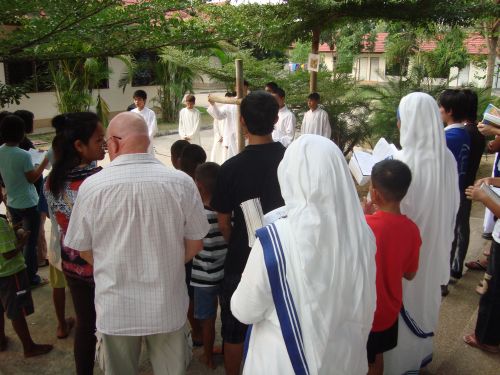
This afternoon, the youth in the church led the Stations of the Cross outside the church. It was a rather grand event with the youth taking turns to carry the cross and lead in the prayers. Even though the number of parishioners in attendance were not as many as wished, but the event was nevertheless deeply moving and crystalized well the spirit of Good Friday. I was very proud of the youth today because they were very willing to take part in this deeply important activity.


Nong Bua Lamphu, 2 April 2010